Grow or Die :Self Development 101

Grow or Die.

While this saying is typically applied to the business world, and may in fact have little basis in reality, it actually has more relevance for us as individuals.

Our capacity for growth is one of the key things that make us amazing individuals and as a species. We just aren’t stagnant creatures. We are explorers, builders, thinkers, and creators. We are constantly changing, remaking, testing and learning as we adjust our environments striving for improvement.

We have the capacity as individuals to grow and improve. While that individual capacity exists in each of us, we have to be willing to consciously tap into it and make the most of what we were given. Your talents were gifts handed to you. How you grow them, expand them, and put them to use is up to you. 

Own Your Growth and Achievement

Self development should really be seen as a life-long process. We should always be setting goals, learning, striving, and achieving goals as we grow. Celebrate that success and then rinse and repeat. There is more to do and the doing can be a lot of fun.

Personal growth is a two sided coin : self awareness of who you are on the one side and growing into who you need to be to meet the challenges and goals you have, on the other. Working through this process of both clearly understanding yourself and challenging yourself to reach your maximum potential is what development is all about.

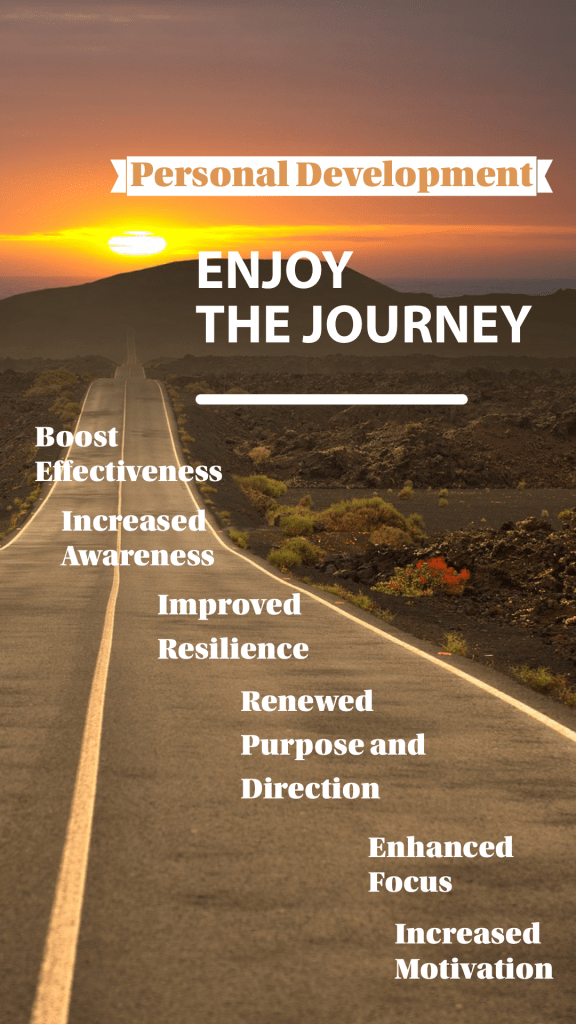
On this journey, you will open up opportunities for:

  • Increased Motivation
  • Enhance Focus
  • Renewed Purpose and Direction
  • Improved Resilience
  • Increase Awareness
  • Boost Effectiveness
  • Rewarding Relationships

Taking steps to improve yourself is a process. It doesn’t look exactly the same for everyone and depends on where you are and what you are trying to accomplish.

The time it takes to even make movement in one area or to meet a goal looks different for everyone. The important part is that you are committed to improvement, open to learning, and stick with it.

4 Key Steps to Successful Personal Development

There are 4 overall steps to having a successful personal development journey. Vision, Awareness, Plan, Sustain and Renew.

Vision – This is where are you going? You’ll never get where you want to be if you don’t know where you want to be. Pick your destination.

What do you want? Who do you want to be? When you think of your future life what do you envision? Do you know what it looks like 5 years from now or 10 years from now? If you don’t know what you want, then it is very difficult to develop in a specific area since you don’t know what your purpose is.

Awareness – What is in your pack? This is what you have to work with and what you are taking with you on your journey.

How aware are you of your individual talents and opportunity areas? What are your Strengths? What are your weaknesses or opportunity areas? It’s important not to focus in on weaknesses, but at this stage it is important to be self aware and know yourself. Do you have a good gauge of these things?  Have you checked your picture against how others around you view you? Do you know where to go to get feedback and a more accurate picture? 

Plan – This is your map to where you are going. 

Having a personal development plan is critical. Knowing what you are working on, the act of building a plan and keeping track of progress is the only way to know where you are going and if you are getting there. The plan should be specific. What are you working on? What will you do? How much? When? What is the measure? Think SMART goals.

Sustain and Renew – Take your bearings and check your surroundings. You made it to the x on the map, but are you really where you want to be. 

After completing the steps on your plan are you where you want to be. You can complete all the steps and possibly be off target still. That’s okay. Take stock of where you are, how far you’ve come, and what do you need to still do to hit the target you have. Adapt to what you have learned this far in the journey. Once you are sure you made it, then you need to ensure that this new behavior is sustainable. How will you keep this skill alive and not allow it to atrophy once you take your attention off it?

Final Thoughts

A word to the wise because I’ve been there.

Don’t get lost in forms and processes. A blank piece of paper can be daunting.

There are some techniques we will cover later for questions you can ask yourself to make this process easier. It should challenge you but not be a burden of monumental proportions.

Afterall, you know yourself better than anyone else. And if you are having difficulty with the plan, there are lots of resources out there, contact your HR department, a mentor in your professional world, or a developmental coach.

Now, go forth and enjoy the journey to a better and happier you. 
Driving in circles :Are you Busy being Busy, or are you truly Action Oriented?

Look closely and you will see an ugly little truth that no one really wants you to see.

Those who are always busy, they expect you to be busy, are competing with who is the busiest, and are judging you if you aren’t running as fast and hard as they are.  They don’t want you to notice that they are moving quickly, but going no where.

Sure,  we’ve all seen that some of them look very successful. They are in positions of power. They are getting the promotions and get put on the big projects.

This is the shell game. It propagates the myth that if you drive hard and fast, you will get results.

Look closer. We are getting conned.

They don’t want you to see that they are not accomplishing much. They are also, probably, working for another fellow, busy person.

If you really watch you will see these people don’t actually hit goals. They make quick action plans. Usually recycled plans over and over. But every time a goal isn’t where they are expected to be, they order up another rehashed action plan and jump in quick. They are in everyone’s faces about forward motion.

They are always in motion. Constantly moving. They don’t ever slow down.

The talk about accomplishments, sure, but those are ones that happened that were never planned on. Either it wasn’t on the action plan or they have so many plans that they can always point to one of them as having been correct.

At the end of the day, whatever does happen, it wasn’t intentional and inevitable. Looking in the rear view mirror they looked for what went right and publicize on that. It’s like playing pool and never having to call your shot.

There are always so many new plans, new goals, and no one every really notices that there is lots of motion but there aren’t really true results. Nothing high up on the goals list ever gets scratched off the list, it is always lots of the low and medium level daily and weekly goals and tasks that always gets done. 

Busy doesn’t count. Everyone is busy. Everyone is busy being busy, looking busy, stressing out about no time because they are busy.

Stop with all the busy.

Busy people have lost their sense of direction and purpose. Busy people aren’t accomplishing anything just trying to convince you and themselves that they have.

I’ve been there, I became one of the busy people. Competing with others for hours worked, how early I got up, how late I worked, constantly in motion and working. It is a merry-go-round to no where.

Working hard is important and action is critical to getting things done. We can’t sit around and dream all day, or analyze every aspect of a situation while never getting around to the doing. Doing things for the sake of doing without a direction and plan is just as dangerous and accomplishes just as much.

The key to realizing a dream is to focus not on success but on significance – and then even the small steps and little victories along your path will take on greater meaning.

Oprah Winfrey

Now, when you marry action, (Idea- Plan-Action) with purpose you get results.

Actions must be married to thoughts and plans. It must be persistent and consistent. It is what you do over and over again that fits into your long term goals. This makes the result inevitable.

Success is the sum of small efforts, repeated day in and day out.

Robert Collier

This is why if you want to make a big difference, make steps every day. You can improve your skills at being an action oriented person who has goals and meets those goals in living their purpose.

That is where the magic happens. 

A journey of a thousand miles begins with a single step.

Lao Tzu

Take those steps and take them in a direction that leads you on the journey you set out on. Take the first step and then the next one after that. Stick to it. That is the key.

Almost every idea worth doing, no matter the barriers that get in the way, will work out if you are persistent and consistent.

Politeness : A touch more civility goes a long way

I’ve always thought of myself as being polite. 

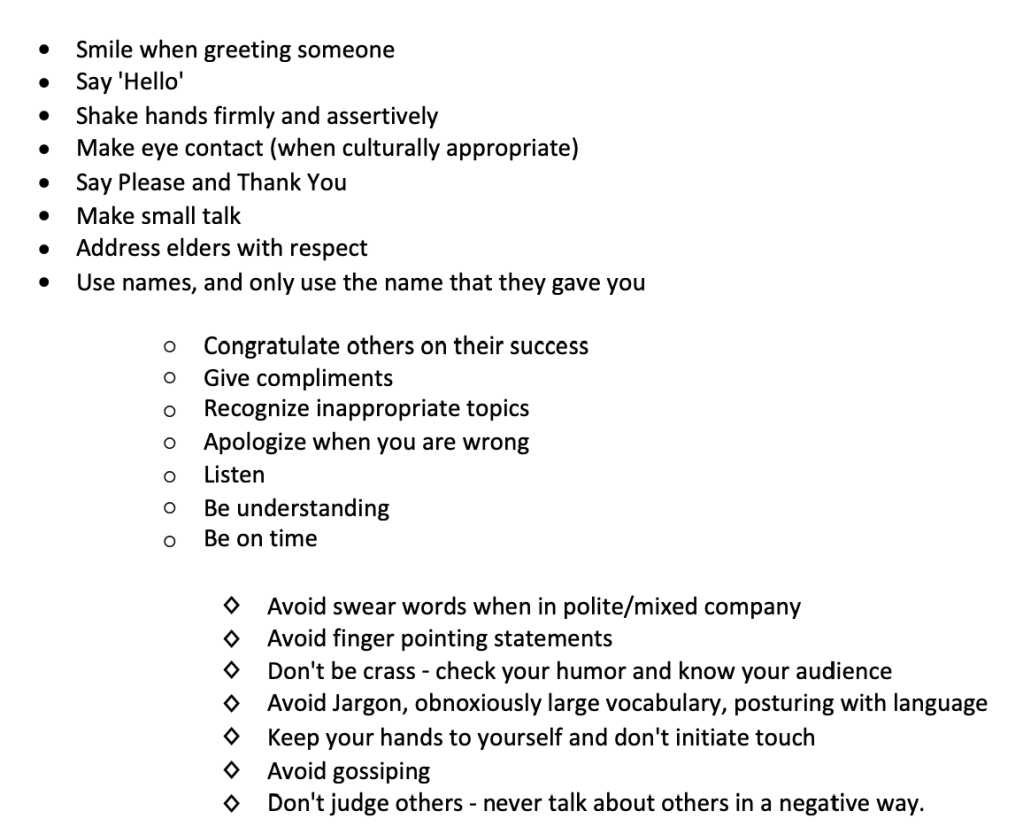
  • I say my please and thank you’s. 
  • I hold the door open for others as often is possible. And sometimes annoyingly to the group I’m with, as they are waiting for me to finish door duty. 
  • I don’t curse in mixed company and never first when meeting someone.
  • I always use the name they gave me after we’ve met.
  • I don’t gossip and an obsessive about keeping confidences
  • I’m not on my phone when others are around. I try giving my full undivided attention to whomever I’m with. 

Sounds pretty good, right.

Until I really dug deeper. There are still a lot of areas that I can work on to be a bit more polite, and to show a bit more courtesy.

Because at the end of the day, a little civility can go a long way.

We live in an increasingly divided and disconnected world, at least disconnected in a interpersonal way. Our devices keep us tethered to one another, to information, to every sort of news, to every convenience that can be instantly purchased and delivered to our waiting …well, I was going to say doorstep, but now it’s wherever we are.

Connecting personally with one another that is another thing.

Before we can be connected we have to be polite, to be good, decent citizens and upstanding folk who have good manners and respect one another. 

Politeness sits right along with kindness, integrity, empathy, modesty, patience and trustworthiness.

Compassion is a subset of politeness where you are emotionally concerned about others, are a good Samaritan who is responsive to the misfortune of others. They live in the same sphere but are different parts.

With a little work and mindfulness this is something we each can improve.

In general, these reminders below work for most interactions, but be mindful of your local customs and social norms. Such as smiling when meeting someone is not universal to all countries and cultures.

The crucial part is in your motivation that you are showing consideration for others, are tactful, and adjust to the social norms of who you are interacting with.

Gossiping and judging is a tough one for a lot of people. The desire to connect over negativity can be very seductive and damaging.

Sure, you can score points with some people when you gossip, share embarrassing information about others, or get on the negative bus with them pointing out the flaws in others.

It just isn’t polite. –And it signals to them, even if they like it, that you will do the same with others about them.

Whatever you do, don’t ever stop being polite. It is part of being civilized people in a civilized world. Thank you, very much for bringing more kindness and civility into our world.

We only think we are good at Listening

In the age of communication there is a lot of talking going on. Without listening, is it really communication or is it just noise?

A whole host of competencies rely on listening skills. If you have any desire to communicate to be understood, to convince anyone to do anything, to be a leader, a negotiator, if you want to develop trust with those who work with or those you lead, if you want to have any chance at connecting with others – listening is at the heart of it.

Why aren’t we better at listening?

The biggest barrier to being good at listening is you probably don’t think you need to work on it. In a multitude of studies conducted with thousands of subjects, nearly all respondents felt they communicated as effectively or more effectively than their co-workers.

Most people feel that listening is important. It’s just that they feel they are good enough at it already. Coupled with the fact that according to research the average person only listens with 25% efficiency, there is a huge gap here in skill that certainly is contributing to a lot of misunderstanding, conflict, and unneeded strife.

Listening is more than hearing. Hearing is a function, it is passive. Listening is about your desire to understand another’s message and point of view.

Spotlight on the speaker

Typically, when someone else is speaking, even when we are doing a good job of paying attention, we are still thinking about what they are saying that we agree with. We are thinking from our perspective, from our vantage point, and with our own self interest.

Put the spotlight on them and all your effort on trying to understand what they are trying to communicate. Your focus, makes all the difference.

Top 3 Barriers to Effective Listening

  • Distractions
    • We get distracted by our outside world and our inner world. -Thoughts, thoughts, thoughts are louder than the loudest noises and distractions outside. Be mindful to change your environment so that you can hear and be present for the conversation. Changing your mind and maintaining self control over mental distractions will take practice. 
  • Attachments to personal beliefs and values
    • Reduce or eliminate strong attachments to your point of view.
  • Misinterpretation 
    • Thinking you’ve got it when you don’t. It is common to misinterpret what we hear when we are listening to someone else. Our brain is looking for what is familiar, what fits into our perspective, and our experience. Mix in a dose of preconceived ideas and it’s easy to get the wrong idea of what we are being told.  

Active listening is about trying to get in the speakers head, to truly understand and grasp the meaning behind the others persons words. – the fully intended meaning from the speakers communication.

There is so much noise going on in our minds. This makes it difficult to listen to others. We have to find a way to clear our minds. Take a moment, to let go, and neutralize feelings so that we can bring our focus to where it needs to be.

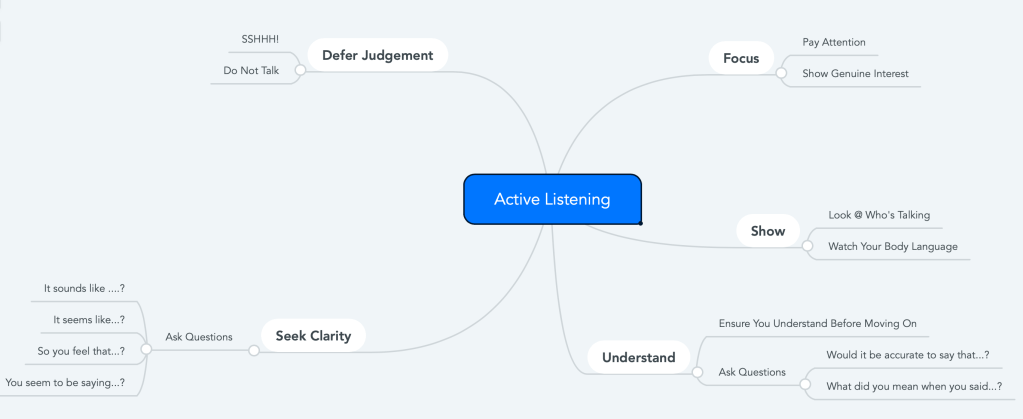
5 Primers for Active Listening

  • Focus -Pay Attention- Show genuine interest
  • Show – Watch your body language – Look at who’s talking
  • Defer Judgement -SSHHH- Do not talk
  • Seek Clarity – Ask Questions
  • Understand – Ensure you understand before moving on

Seeking Clarity and Understanding are the reflective part of active listening.

Examples of Reflective Listening Phrases

  • It seems like…?
  • It sounds like….?
  • So you feel that…?
  • Would it be accurate to say….?
  • What I’m hearing is…?
  • What did you mean when you said?
  • You seem to be saying…?
  • You are…?

Practice Active and Reflective Listening

It takes practice to get good at active listening.

Don’t let the technique go wrong by not being empathetic and authentic. Be sincere in your desire to listen and to help better understand their point of view. We all feel it when it is inauthentic and the paraphrasing statements and clarifying questions sound wrote and forced.

It’s important to be observant. To be able to fill in the blank with what you think is really going on. This shows that you are listening, observing, that you care enough to notice. It also allows them to clarify. This way you are reducing misunderstanding.

We are looking to be heard. Some are shouting from the rooftops to be heard and to connect with others.

If you are more willing to listen to someone else, they will be more willing to listen to you. Otherwise, it is just two people making noise towards one another.

Set yourself apart from the pack by developing and mastering your listening skills. There is a lot of noise out there. Care enough about others that you are actually communicating. Be the one who actually understands what others are trying to say. It will open up a whole new world when you tune out the noise and hear the beauty in the message. 

Execution : A Test of Choices, Trade-offs and Perseverance

You know your purpose and mission. You know your goals. You’ve taken your idea and turned it into a plan. Now, it’s time for action.

A-C-T-I-O-N

As long as you know what you are measuring, managing, and the behaviors you are looking for, then you are almost ready to get moving.

However beautiful the strategy, you should occasionally measure the results.”

Winston Churchill

The reason I say almost, is that more than 80% of strategies that leaders put together fail to meet their goals. Execution is where everything falls apart, but most of the time it is because we’ve missed a few pieces along the way.

When developing a plan to execute upon it comes down to a series of choices and trade-offs. You are choosing to spend your time on one thing and not another. At each level of the plan, it is about what you are choosing to do and what not to do.

If we fail to understand those choices, or if we are unwilling to completely embrace these choices, then the plan will start to unravel through the execution phase. Doubts will creep in. Resistance will mount. Priorities will shift. Other plans or tasks will compete for attention.

Whether your executing something as an individual or you are focusing a team on executing a plan, there are some common issues that creep up. Whether it is because we or others are losing focus, we don’t have sustainable actions, or we are lacking the passion to keep connected with the day to day work. We all face these issues each time we are trying to accomplish our goals.

“Complexity is the enemy of execution.”

Tony Robbins
  • Eagle Eyes – Keep your focus sharp. Focus means keeping your eye on one thing. No when to say no. Keep the message clear and sharp.
  • Establish Habits – Repeatable systems. Clearly defined roles for each person where you know what you will do, day in and day out.
  • Keep the Fires stoked – Keep the story alive on why this is important.

“It is only by saying ‘no’ that you can concentrate on the things that are really important.”

Steve Jobs

Execution as a competency comes down to self awareness, being factual and embracing reality, setting clear goals and priorities, being results driven, following through, and ultimately about perseverance.

To execute effectively it is important to set clear priorities, set measurable goals, consistently review data, and measure and evaluate progress.

When working as part of a team sharing information with continuous communication is critical to keeping the effort moving forward. And of course we all need to celebrate success, and make necessary adjustments when things aren’t working.

While it takes a lot of different skills to move a strategy or goal through to successfully executing on it, sticking with those choices and trade-offs and persevering is the real test.

If you haven’t done the planning and strategizing, if you aren’t comfortable with saying no or sticking with the choices you’ve made even as barriers and resistance mounts, then it becomes almost impossible to see it through to the end.

Do the work and the planning, put your skills to the test, and then commit.

When you see it through to the finish line, and are able to inspire others to keep going to the finish line, then you will join a very, very small club of leaders who can execute. 

Building Credibility and Professionalism through Mastering Tact and Diplomacy

Are you regularly hurting other people’s feelings?

Struggling to get others to accept your feedback?

Frustrated that you aren’t getting what you want?

Don’t have the influence that you want?

You are right, why won’t anyone listen?

If any of this sounds like you, you may need to build your skill at tact and diplomacy. It is one of the key aspects on the road to building the Influence competency. Within this domain of Building Rapport, Politeness, Active Listening, Assertiveness, Developing Trust, Empathy, Emotional Intelligence, and Negotiating – Tact and Diplomacy leans and builds on these competencies.

Let’s face it, how you communicate can make or break your career. It affects your relationships at work, out in the world, and with friends and loved ones. Husbands, wives, partners, kids, parents, neighbors, everyone. It’s how we connect, and it matters.

If we are taking the time to communicate with another, and to provide feedback, then the goal should be to connect. Connection is a two-way street. And, to do that means we need to consider other people’s points of view.

Typically, those with opportunities with tact and diplomacy rate high for personally getting things done, moving forward regardless of resistance, and unapologetically saying what they think . They may have a reputation for being blunt, saying it how it is, or even being abrasive, rude or aggressive. Others may still follow their intimidating approach and do as told but the interpersonal cost is very high.

By developing tact and diplomacy you still tell the truth, provide feedback, and get things done. By choosing your words and ensuring they are carefully selected for the person and situation after considering their feelings and reaction – you will get more done while maintaining and possibly strengthening the relationship.

Those who display a high degree of tact and diplomacy can treat others fairly, regardless of personal biases or beliefs, and can communicate in a truthful, clear manner while tailoring that conversation to the individual in a sensitive and effective way.

Developing Tact

  • Create the right environment
  • Determine the appropriate time
  • Think before you speak
  • Choose your words carefully
  • Body language must match what you are saying
  • Never react emotionally

The more we become interconnected in this world, where we are working and interact with increasingly diverse and unique people, we must build our skills with tact and diplomacy in order to maintain positive relationships with others.

There is little in this world that we accomplish on our own. And our ability to interact with others is one of the biggest factors in accomplishing what we want to with our time.

This means considering others communication style, their feelings, and their possible reaction.

This does not mean shying away from the conversation because of how someone will respond. It is about tailoring the words used and the conversation to the person and situation to get the best outcome. It does little good to provide feedback, if the feedback provided is done poorly and increases the chances that the information didn’t get through.

When giving feedback

  • Keep focused on what you want to achieve
  • Be explicit factually: be precise
  • Remember your desired outcome
  • Step back from emotions
  • Find common ground
  • Two-Way conversation

If we are taking the time to communicate with another, and to provide feedback, then the goal should be to connect. Connection is a two-way street. And to do that means we have to consider other people’s points of view.

Being sensitive and direct by showing emotional sensitivity to others and considering others point of view, feelings and reactions preserves the relationship by demonstrating thoughtfulness and builds credibility.

Tact and Diplomacy builds your professional character by demonstrating maturity, shows integrity, good manners, and sound judgement as a considerate person who leads with finesse and grace, and one who has acceptance and respect for diversity.

Follow Through : Be Someone Who Gets Things Done

There’s a six-word formula for success. Think things through, then follow through.

Eddie Rickenbacker

Words are meaningless without intent and follow through. Without follow through there is no action. You are breaking a commitment with yourself and others. This leads to erosion of dependability and trust.

Watch the commitments. It’s so easy to want to help others, to want to say yes, and if you are regularly saying yes, then watch it. Before you say yes, remind yourself that right now you (motivated you) is putting your reputation on the line for something that later you, may not be as motivated to actually see through. Think it through for a second before you commit or over commit.

Character is the ability to follow through on a resolution long after the emotion with which it was made has passed.

Brian Tracy

What do you want?

Understand what you true goal is, what is at the heart of it, and be very clear with yourself on the goal.

Tradeoff

What are you giving up? It’s important to come to terms with the choice you are making. Choices are a matter of tradeoffs. If you haven’t wrestled with this, it may come back to haunt you.

Timeline and Deadlines with waypoints

You must have an end date. Breakdown your goal into a timeline of action with deadlines along the way. Know what you will do and by when. Hold yourself to it.

Schedule it

Like any commitment you make, schedule it. It’s no different than a dinner date or a doctors appointment. Put it on your calendar. It’s not a real commitment if you don’t schedule it.

Habits

Any task or goal that takes a while to get to the final result takes work. The more opportunities to decide if you will do a thing, the more likely a barrier will present itself and you won’t follow through.

Develop your habits so that the goal you have is being worked on regularly and nearly automatically. You don’t decide on if you are going to make movement, you just follow your habits and routines.

Accountable

If this is an individual goal then include a friend or mentor. This will help you keep accountable to yourself and apply some social currency to the situation. It’s harder to give up and admit defeat when you’ve shared it with someone you respect and that you want to keep respecting you.

If this is not a an individual goal but one you’ve agreed to complete for someone else, you are accountable to them. Your reputation is on the line and so is your character.

Overpower Fear

Fear is normal. It is inevitable. We each work through it differently. The key is to work through it and not allow fear to become an insurmountable roadblock. Work through it and keep moving forward.

Close the Loop

Get it done. Deliver on what you said you would and get that thing done. You’ll feel good. You’ve made forward progress. Celebrate with a quick pat on the back and then get on with your next goal. Time is precious.

You have to have confidence in your ability, and then be tough enough to follow through.

Rosalyn Carter

There are a number of reasons you can struggle with not following through on your commitments. If you regularly find yourself having issues with follow through consider a couple of things.

Do what you love

Are you doing what you love? If you are not spending a significant amount of your time using your strengths in the pursuit of something you are passionate about, this can cause major hurdles to overcome in order to take action.

Simply you have to expend so much energy to force yourself to do something you don’t love, that you may be running at a mental deficiency to get it done. Willpower is not enough. Motivation is not enough. Look at the core of who you are, what your strengths are, and if you are simply committing to a result that may not fit for you.

It’s not enough to want the result, you must also want the action that gets you there. Before you commit to a goal, understand the steps it takes to get there, and love those steps.

If you don’t love the process, and are only working for the result – it will take a herculean effort to stick with it and see it through.

Do what you said you were going to do. Carefully consider what you commit to. Be realistic and don’t over commit. Be clear on what your goals are and what a win looks like.

Enlist the help of others. You don’t have to be amazing at everything. Sometimes you can delegate to others, or take others as partners to get it done.

You’ll feel much better about yourself when you follow through and accomplish what you set out to do.

MMM: Make Monday’s Matter

It is common to bemoan the coming week. So many of us survive our Monday-Friday and live for our Saturday and Sunday’s. The math doesn’t add up and still we sacrifice five days so we can do what we want on those two days. Misery loves company and I hate Monday’s is a common refrain we hear from friends and co-workers.

We are leading double lives and it makes it difficult to transition from one life to the other.

It’s time to wage war on Monday’s.

Our way of thinking is completely out of whack is a causing a great deal of undue stress and unhappiness.

Monday’s are not the problem. We are. It’s only a day of the week. We give it a lot of power over us, with the way we think and the way we communicate about Monday. And about our week in general.

I hate Monday. Wednesday Hump Day. TGIF, thank goodness it’s Friday.

Let’s reclaim our week and make it our own.

Soul Searching

If on Sunday you get blue thinking about the coming week and having to start another week of of doing it all over again.

If you say, you hate Monday’s or are posting that you survived Monday regularly, it’s time to take a good look at your job and career.

Are you doing what you love?

Is what you are doing fulfilling your “mission and purpose”?

Do you feel like you are making a difference that matters to you?

Are you using your skills and talents to their fullest?

If not, you know you have a problem and need to do something about it.

Sunday

Think about what the week will look like. Write down your three top priorities. What is one thing you will do this week that will make you proud? Get a good nights sleep. Go to bed early.

Monday

If possible, get some exercise in the morning before you head to work and get their early. Get a jump on the week. By being their early you will skip past the Monday morning gossip, water cooler chats on weekend activities and you’ll knock out a couple of priorities before other have even started their day. If you can get one thing done that you dislike the most, and have that knocked out before the day of distractions gets going. You’ll have already accomplished more than you did last week.

Just a few tweaks to how you think and what you are doing can really make a huge difference in your mental health, productivity at work and your sense of accomplishment at doing more than just trading money for time.

Get Over Yourself Already, and Delegate

The biggest barrier to delegation is you.

You heard that right.

It isn’t your people.

It isn’t their skills. Or motivation.

It’s you.

Do you find yourself not delegating because 1) You don’t want to overburden your team 2) You think you can do it better or faster yourself 3) you are a control freak and just can’t let go?

You need to look hard in the mirror.

If you care about the growth of those around you then you have to be willing to delegate.

If you care about your growth then you have to be willing to delegate.

If you want to stay being a control freak go back to being an individual contributor. You are already one, just one with a fancy leadership title. We need lots of amazing individual contributors. Go be one. Leadership is not for you.

One of the competencies one has to master in order to be a successful leader is delegation. It’s about empowering the members of your team to be accountable to make decisions and complete tasks and projects. Assigning the authority to the right employees while taking their growth goals and competencies into account.

Don’t tell people how to do things, tell them what to do and let them surprise you with their results.

George S. Patton

Delegation is not about telling someone else what to do.

It’s about building trust in their integrity and competency and giving them the opportunity to grow or make use of their talents and do the work they love. It’s the only way to allow yourself as a leader to grow and give yourself the space to spend time on those things that you are best suited to be doing.

You probably got promoted the first time because you were an excellent individual contributor. You know the ins and outs of the job very well.

Just one problem. It isn’t your job any longer.

Whether this is your first time being a leader or you’ve been doing it for years, how you handled delegation early on helped define you as a leader. There are many leaders who have stayed in the bucket of being managers because of their relationship with delegation, or rather their lack of delegation.

You may be one of those who have a team but really do most of your work as an individual contributor. They do their work and you do yours. You manage them when things aren’t getting done.

Surround yourself with the best people you can find, delegate authority, and don’t interfere as long as the policy you’ve decided upon is being carried out.

Ronald Reagan

Ask yourself:

  • Am I the only one who can do this task or project?
  • Is there someone who is better at this than me?
  • Am I the bottleneck for others getting their work done? Who is waiting because of me?
  • Do I have anyone that I trust their judgement so they can take over this task and remove me as the bottleneck?

Just because you can do a thing, doesn’t mean that you should be the one doing the thing. If you look up and you are the only one that can do the task or project, and it isn’t just you being a control freak and not being willing to let go, then you have to do the task.

Be careful, just because you can do a thing and do it well, doesn’t mean you should be doing the thing. Is it what you are best at? Is it what you should be doing with your time in your role?

Deciding what not to do is as important as deciding what to do.

Jessica Jackley

As you build trust in the integrity and the competencies of your team members, you can use different levels of delegation that fit the person and situation.

Do As I Say – This is instruction. Follow these instructions precisely.

Look Into This – Here you asking for investigation and information but no recommendation.

Give Me Your Advice, We’ll Decide Together – Coaching and Development level that encourages a shared process

Explore, Decide & Check With Me – Here you trust them to dig into the situation, gather information, synthesize a decision and want them to check in before proceeding.

Explore & Decide Within These Guide-rails – Here they can move forward within clearly established parameters. They don’t have to wait for you before taking action, but they don’t yet have complete autonomy of decision and action.

You Own It – This one can have different levels depending on how they have done along the way. You can choose for them to inform you when it is all done, they can take care of it and do not need to check back in with you, or it can be where you give them complete freedom to take action, manage the situation and own this area going forward.

When you delegate work to a member of the team, your job is to clearly frame success and describe the objectives.

Steven Sinofsky

Outside of the different levels of delegation is the basic delegation process itself.

Assess

  • What are you delegating?
  • Who to delegate to?
  • Assess the competency (ability), suitability, and the required training of the individuals you are considering
  • Pick the right person

Set Expectations

  • Set clear objectives
  • Explain the reasons why this is important
  • Required results
  • Agree upon deadlines
  • Agree upon cadence of check-ins and progress to be shared

Provide Support

  • Be available
  • Check in as agreed upon
  • Monitor progress
  • Provide feedback, expertise, coaching as needed
  • Encouragement is important

Review

  • Follow up and provide feedback on results
  • Celebrate accomplishments
  • Review what they learned from the assignment, what are they proud of? Where do they want to make adjustments in how they did things or areas they want to learn more about for next time?

To be a leader you have to be willing to delegate. You may be a star but if you go it alone, then you are limited in what you can accomplish. To have a big impact, you must have the mindset and humility to know that you can’t do everything yourself and that you should be working on work that only you can do.

Only then, are you closer to having the larger impact that you are looking for.

The Road to Efficiency is Paved by the Organized

To improve efficiency, you have to be organized. 

You can lose a lot of time due to disorganization. The longer it takes to find what you need ends up wasting your most valuable resource – Time. The more stuff that you have the more work it takes to find stuff.

Without organization you work on what is in front of you, rather than by priorities. It’s extremely difficult, if not impossible to be efficient with resources if you don’t have those resources organized.

Improving your skill at efficiency and organization takes working on competency at Time Management, Prioritization, Scheduling, Optimizing, and Delegation.

Organizing is what you do before you do something, so that when you did it, it is not all mixed up.

A. A Milne

Build the habits that make organization simple.

  • Value your time. You don’t waste what you value. Get the most out of the moments you spend. 
  • Schedule but don’t over schedule. Lots of little things that still needs to get done will eat up time. Don’t over commit and schedule every minute of your time. Work ahead of Schedule – set deadlines ahead of when it needs to be done. Treat this deadline seriously.
  • Unclutter your life – Remove what doesn’t add to your life. Everything has it’s place. Before you add, subtract, and always know exactly where anything will go before you bring it home. 
  • Keep Track – write it down. Notes, planner, post-its. You can’t organize if you don’t write it down. Record those commitments.
  • Do – You can’t just keep adding to your to-do list. The key to all of this organizing and efficiency is to take action. Knock out the most important priorities and celebrate those wins, especially the small ones. 

Clutter is nothing more than postponed decisions.

Barbara Hemphill

To become a more organized person, there are four areas to concentrate on first.

Organizing your space

Your environment is important. You adjust to your environment. It has an affect on your mood. Declutter your mood.

Clean up your house, your car, your desk. It isn’t just about being clean. It’s about having things where they belong, where it is most efficient or beautifies your space.

Give yourself something nice to look at.

Organizing your work

Have a system of organization for keeping track of your work.

As in all things, simplicity is key.

Keep like things together. You need to be able to find what you need in a moments notice. For example, for every meeting you have on the calendar – you need everything at your finger tips. Whether going traditional and using a folder system or going electronic with One Note, Evernote, it’s important to have a system where everything can be accessed at any time.

Organizing your priorities

First step in organizing your priorities is knowing your goals. What is important to you?

Have a system for prioritizing. A, B, C – Whichever system works best for you, it needs to be able to allow you to simply separate the Urgent from the Important.

Be realistic in what you can accomplish. Knock out what is the most important. Keeping everything organized means knocking out more things off your list each day, than you are adding to your lists.

Organizing your resources

Know what you have at your disposal. What resources do you have?

Delegate. Not everything has to be done by you. Even if you are a single contributor without direct reports, you have others in your life.

Nothing says you can’t ask fellow co-workers to help put their talents to use. If it is something that plays to their strengths, and they can deliver quality more efficiently then you can, then give it away and ask for help.

You can ask your partner or family for help. Or if you have the resources you can outsource and pay someone to do the things that need to get done but may not need to get done by you.

Wrap Up

Efficiency is about doing the thing right.

Effectively is about doing the right thing.

To work efficiently and effectively, we must start with the foundation of organization. Haphazard creates a lot of mess. Being organized is a personal skill that threads it’s way through our lives in different ways. Build your reputation by working through these core competencies on your path to improved efficiency.