Vomiting My Way To Success

Life shrinks or expands in proportion to one’s courage.

Anais Nin


It may be an overstatement, but not by much, to say that most everything worthwhile that I’ve accomplished in this world came from my pushing through fear and finding my courage to do something that I’m afraid of.

For instance, I’ve always been afraid of speaking. Public speaking really. And by that I mean, speaking to more than one person.

For much of my life I was a shy, introverted kid. I didn’t understand other people and I’d been exposed to a lot of cruelty and ridicule at an early age.

I read a lot. I was always learning and testing things out. I could see patterns in things. I was always cross referencing different subjects against one another. Looking for ways that things interconnected and informed one another. It seemed that I saw things that others didn’t.

And for a long time, I didn’t know how to articulate what I saw. I’d jump to the end much too quickly and others wouldn’t follow where I was headed. Not being able to communicate well and explain, I found myself ostracized from others. I felt like an outsider and an alien.

The best thing I could do was shut up. I avoided ridicule, or at least lessened it by not speaking up even when I knew the answer. For a long time in my life, nothing good ever came from speaking up.

And this is where I think my fear of public speaking was born.

I also had and still have something inside of me that is trying to get out. It can’t be contained. And so I’ve raised my hand to speak in front of groups.

Time and time again, I get up the nerve and I go make myself do it. It is stronger than my fear. Sometimes, my fear wins and I’m quiet. Eventually, this something else inside of me, rises up and I cannot be contained.

When I do speak in public, whether it be in front of 5 people or 1000, I’m always nervous. You’d think that would go away at some point. But it never has.

Until about a year ago, I always, always threw up before any speaking engagement. While, my pre-show vomiting has started to subside, I still always have that fear inside of me, that almost panic at the last moment that I don’t know what to say and that I can’t do it.

And still I would always go back for more, and each time I’ve upped the ante of difficulty.

This fear, for me, is more about putting myself out there in front of others, telling what is in my head and being afraid of looking stupid and others not accepting me for who I am. I know most of the logical reasons why this really shouldn’t be a thing. And each time that I put myself out there – I’ve gotten something amazing in return. I’ve grown each time.

And so I keep putting myself out there. Every word I write here, every post I make, every video I shoot, or article I write – there is the nasty blade on the end of a pendulum swinging ever closer to me. It is the fear of this unknown thing that could happen to me if I keep putting myself out there. That once and for all, the world will deem me unworthy.

I imagine that for others this is silly. For me, it has been my constant companion.

I’m not sure if it is comforting to know that I’m not alone, and that every one has fears.

Many are possibly biologically built into our sense of survival and considered to be linked to humankind’s early days of survivability. Walk out in the wilderness and step on a venomous snake or spider without access to medical care and you’ll easily imagine how this one got built into our collective unconscious fear response. The world was a dangerous place for our early ancestors.

Study almost any list of the top fears and you’ll always find some variation of the following:

  • Dogs
  • Germs – With the Covid-19 pandemic, this one may be gaining some traction for a lot of people
  • Needles –
  • Storms – Thunder and Lightening
  • Snakes
  • Insects
  • Spiders
  • Flying
  • Enclosed Spaces
  • Heights
  • Open Spaces/Aloneness
  • Social Phobias – such as public speaking

These affect people in a wide range of ways, from a strong dislike and fear, to a full on psychological phobia. They can be quite debilitating for those that are afflicted with a severe case of any one of these.

There are also a lot of fears people have that hold them back in life.

These are areas such as loss of freedom, inadequacy, being judged, getting hurt, uncertainty, rejection, failure, loneliness, and change that hold people back. These fears can run deep. And it seems fairly clear that most people are dealing with or have dealt with at least one of these.

I’ve certainly felt most of those at one point or another. And still our ability to confront these with courage is the only real measure of our success in growing as a person.

For me, I’ll continue to ratchet up the fear factor. I’ve learned to use that energy and turn it back on itself. I use that anxiety as fuel to be absolutely in the moment when I speak. I believe that there is something to be found on the other side of this fear, if only I can keep going.

Keep writing. Keep sharing. Keeping getting up on a stage or doing a video and putting it out on the internet.

I do have a need to be seen. Not for fame. Or glory. But because, there is something on the other side of that fear. I just know it. If I can share with just one more person, and one more person after that. —There is something amazing out there, connecting with others, helping others.

 I just know it.

And so I keep writing for my life, sharing, putting myself out there, and I know something good will come from all of it.

Not Everyone’s Cup of Tea

I’m pissing some people off. I mean, really making some people banging on their keyboards mad.

Not intentionally. Or rather, I don’t do what I do with the desire to make others mad.

But, wow, do some people have some anger issues. And others, are really invested in seeing someone fail.

My first reaction when I read these messages is to get mad, and then when that subsides, I try to figure out what I perhaps did wrong and why they are so upset.

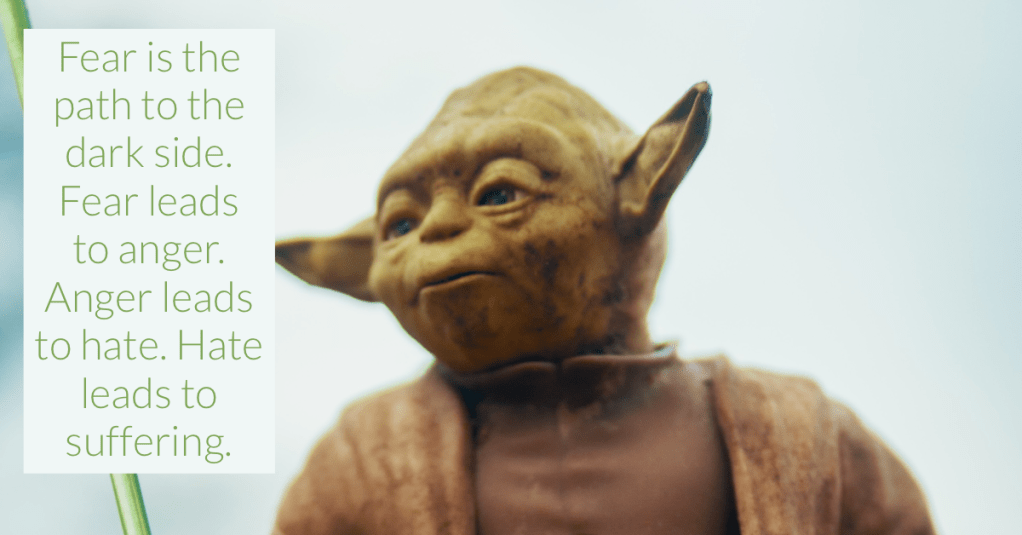
Master Yoda

I’d much rather that it didn’t bother me. The stoic side of me says not to give it a whole lot of thought. After apologizing, if I did something wrong, and acknowledging how they feel, there isn’t that much to do. If I have a pattern and it points to an area that I need to make adjustments, I surely will.

Then when I think about it some more I do actually smile.

It probably means that I’m doing something right.

I’m not everyone’s cup of tea. I know and have been told on numerous occasions that I’m a bit too much. Which is probably just the right amount of too much. There is no way that everyone is going to like me. Something as a leader I’ve known from experience for most of my career. There is no way to make everyone happy or to have everyone like you.

Having everyone like you is reserved for some truly remarkable people, who have a special gift. Mr. Rogers and Tom Hanks. But it is a small club. Or it could possibly  be because we love some from afar and never really know more than their public image.

Regardless, I’ve known this for a long time and yet, it is so easy to forget when we are thinking about our virtual world online.

If you just set out to be liked, you would be prepared to compromise on anything at any time, and you would achieve nothing.

Margaret Thatcher

I’m more interested in making a positive impact than I am in people liking me. That just isn’t my mission. Sure, I love when people get something out of what I do. When I can add value to another person, help them with an ah-ha moment, or to come up with a new idea or way of looking at things…wow do I love that. But worrying about people liking me is a sure way to do one thing while forsaking my real mission.

I will continue to be thought provoking. To share more and more of who I am. I’ll make mistakes along the way. I’ll learn and correct. Try my best not to intentionally upset others for no reason.

I’m happy to make friends, but I have no interest in worrying about those who are cruising through life looking to be offended, looking for reason to be upset. You know who you are, so just keep walking.

People get addicted to feeling offended all the time because it gives them a high; being self-righteous and morally superior feels good.”

― Mark Manson

I’ll keep on being civil and polite, but I also won’t be deterred from my mission of growing as a person and helping others grow, finding a different way to look at things and providing tools to help them meet their goals.

Here’s to pissing people off.

It wasn’t the first, it certainly won’t be the last.

I sincerely wish them the best and feel bad that they live in a land of such unhappiness that they have to strike out at others.

Thanks so much for your continued support. I love connections so please ask a question or just say hello. Share this and send with a friend.

If you or someone you know is working on personal growth and building  competencies check out the below articles on politeness, being assertive, and building rapport.

Politeness : A Touch More Civility Goes A Long Way

Stand Up for Yourself Without Stepping On Anyone By Being Assertive

Sincere Connections Through Building Rapport

Thanks and have a wonderful day!

We Set A Low Bar For Leadership

Stop calling managers leaders if they can’t manage themselves.

It’s crazy that we are so badly in need of leadership that we have lowered our standards to such an incredible degree. Look at what passes for leadership now days. We throw around that word so much and it is such an easy badge to be anointed and to anoint ourselves.

We want it so bad. We look around and we want to be inspired. We want to see that leader who makes us jump up and want to take notice. We watch the news and pray for leadership.

You do not lead by hitting people over the head, – that’s assault, not leadership.

Dwight D. Eisenhower

Especially in these times when the world has turned a bit upside down and our daily lives have changed dramatically. We want leadership. Since there is so little leadership out there within plain view, we lower our standards to such a degree that if you sound a bit like a leader, we will take that. Sound a bit authoritative, or like you know what you are doing, or even half way confident and we perk up and take notice. Look there is a leader, well they sound like a leader at least.

Quit setting the bar low for leaders

Here is the deal. If a person can’t manage themselves, they are no leader. That isn’t the only thing needed to be a leader but it is one of the foundational things needed.

I’ll say it again, because I think it is so important, if a person can’t manage themselves, they are no leader. They may be a manager, but they are not a leader.

That doesn’t make you a bad person. Self management is an important skill and one that can be learned. Check out my LinkedIn article, Self Management : First Lead And Inspire Yourself for a primer on how to develop this important set of competencies.

As well as being important for the single contributor, self management is a foundational part of being a good manager and leader. Before you can lead you must learn to manage. If you can’t manage yourself then you’ll never be an effective leader.

Why should anyone listen to us as a leader, if we can’t manage ourselves first?

The answer is, of course, they shouldn’t. You wouldn’t and neither should they.

So, please quit throwing out the title leader to people who just aren’t there yet. I know we’ve created a world where the word manager seems like a dirty word. It’s in so many job titles and yet, we still vilify this word. Only leaders are worthy of praise. And don’t get me wrong, I love that we moved to a world where we are aspiring to be leaders and not just pushing around people like papers on our desks.

And it isn’t that leadership is easy. It isn’t. We are just too quick to bestow the word of leader on someone, when all we’ve done is lower the bar too low.

Your position never gives you the right of command. It only imposes on you the duty of so living your life that others may receive your orders without being humiliated.

– Dag Hammarskjold

Keep aspiring. I worked hard to be a leader and not just a manager. Many people put a lot of time and attention into trying to get it right. They make entire careers out of becoming a better leader.

Management doesn’t have to be a dirty word

We also have to recognize that management is something we need at times as well. This is a skill. And it is certainly a stage that most have to go through on their road to becoming a leader. You don’t just get there without a lot of hard work, development, feedback and adhering to principles.

Let’s just stop with calling everyone a leader. It lowers the bar too much. It makes many people think they can easily do it. Or it begins to distort what real leadership qualities look like. This is how many incompetent people seem to end up in high level positions.

Leadership is a posture and a choice, not a role that must be bestowed on you. Step up and be a leader when no one is watching or expecting you to do so.

– John Izzo & Marshall Goldsmith

When we really think about it we know what real leadership looks like. We see it around us in so many small ways. I know so many people who are leaders in their lives and to others, without ever having been given the title.

There is a quiet leadership revolution that is happening and it is time for it to be given more of a voice. A time when being a leader and demonstrating through actions of competence, empathy, thoughtfulness, intelligence, ethics and principles are given more weight than sounding confident and full of bravado while shouting down others.

A leader is a dealer in hope.

– Napoleon Bonaparte

Here is to the hope that more people cultivate the leader within. The more we demand of ourselves, the more our leaders will have to do to gain our respect.

I am a dealer in hope. Will join me?

How to Be Productive, Never Busy

Action expresses priorities.

– Mahantma Gandhi

Be productive – Never Busy.

You always have time for things you put first. Time is the great equalizer. We all have the same amount of it each day. It is how we use it.

Getting the most out of our time spent requires some organization and productivity. To be truly productive we need a habit, a system that we use daily that fits into our values, goals, and priorities.

Everyone has their favorite productivity system. There are lots to choose from. So choose away. I’m not going to list all the ones out there – there are too many and each has it’s own philosophy that makes it intellectually interesting. Instead I’m going to share what you should be looking for in a system, the best mindset and how to make use of whatever system you choose.

Here are some things to consider when selecting a productivity system.

#1 – Prioritization shouldn’t be complicated. Stay away from systems that can’t be done in 5-10 minutes each day.

#2 – Know your values. Know your goals. And you’ll have an easy time knowing your priorities. If you don’t do this, then you’ll never be able to make #3 work and you’ll be working hard and getting no where.

#3 – Daily task list should be no more than 3-5 items and be more priority based than task based. Three of those should be “best work” items. After you’ve checked off everything from the day’s list, will you have done your best work? If the answer is yes, then you have found the sweet spot for prioritization.

It is not a daily increase, but a daily decrease. Hack away at essentials.

– Bruce Lee

To accomplish the right things that lead you to success it’s good to keep somethings in mind.

If you are able to Eat the Frog, or do the hardest thing or what you’ve been dreading or putting off the most at the beginning of your day – the rest of your day will be all downhill from there. 

Procrastination mounts up the pressure as tasks are looming over our head. The longer we wait the more power they take on, the larger, slimier, wartier, that frog becomes until it is a monster waiting to devour us.

Task List Seduction for some of us entices us into it’s charming lair. The lists get longer and longer. We add more and more to it. It feels good to get those things down on paper rather than in our heads waiting to stab us awake in the middle of the night. Always adding to the list and reshuffling the most important. 

It’s not hard to make decisions once you know what your values are.

– Roy E Disney

We work through complicated systems with letters, numbers, and formulas to find the most efficient way to tackle the immense list that has taken on a life of its own. We know if we find the right system, we can tame the beast and we will find efficiency nirvana.

Except we start to lose sight of the important and the urgent begins to take over. The longer the list and the more of a love affair we have with the list, the more we only get to the things that have to get done today because of a deadline guillotine.

Fight the seduction and keep those lists to those 3-5 items that are mostly priority based. Do, Just do anything that takes 2 minutes or less. Poof it is gone. No list, no prioritizing it, no thinking and stressing about it or forgetting. Just do it. 

And use the SMART goals. If you can’t set a realistic, achievable and measurable goal that can be clearly articulated then you are working on the wrong things. It is that simple. 

Stop chasing perfectionism. The perfect system. The perfect day. The struggle for perfection robs you of time. The effort it takes to move something from 95% to 100% is more than the energy it took to get it from 0-80%. That is a lot of wasted energy for something that won’t net that much more.

The key is not to prioritize what’s on your schedule, but to schedule your priorities.

– Stephen Covey

5 Platinum Rules of Prioritization and Organization to set you free

  • Value your time. You don’t waste what you value. Get the most out of the moments you spend. 
  • Schedule but don’t overschedule. Lots of little things that still needs to get done will eat up time. Don’t over commit and schedule every minute of your time. Work ahead of Schedule – set deadlines ahead of when it needs to be done. Treat this deadline seriously. Leave room for the unexpected.
  • Unclutter your life – Remove what doesn’t add to your life. Everything has it’s place. Before you add, subtract, and always know exactly where anything will go before you bring it home. 
  • Keep Track – write it down. Notes, planner, post-its. You can’t organize if you don’t write it down. Record those commitments.
  • Do – You can’t just keep adding to your to-do list. The key to all of this organizing and efficiency is to take action. Knock out the most important priorities and celebrate those wins, especially the small ones. 

Above all keep it simple. Say no to anything that doesn’t fit your priorities and values. And keep hacking away. Time is relentless and so you must be with your management of your time.

Productivity is never an accident. It is always the result of a commitment to excellence, intelligent planning, and focused effort.

– Paul J. Meyer

Organization : Simplify Your Way Out of Clutter

To improve efficiency, you have to be organized. 

You can lose a lot of time due to disorganization. The longer it takes to find what you need ends up wasting your most valuable resource – Time

Remove the clutter and you are removing the obligations that may come with owning certain items. Having stuff that isn’t getting regular use is wasting the money originally spent on it and the money you are spending in housing things and taking up valuable space in your home.

“Don’t own so much clutter that you will be relieved to see your house catch fire.” 

Wendell Berry

You may not even realize the mental and emotional strain that you are putting on yourself by having so much stuff.

As always, start simple. You may not be able to do an entire home purge. So, keep it simple and go for one room or area of your home. 

Start with whatever is bothering you the most. 

#1-Remove everything. Clear out the space you are trying to organize.

#2-Everything goes in 3 piles

  • Absolutely need! You regularly touch this item. It has a clear use and need to be in your life. 
  • Bye Bye – This pile is the stuff you know for sure you don’t need any longer. You haven’t touched in in the last 6 months. And touching it, to move it from one place to another doesn’t count. 
  • Not sure– You aren’t sure you can part with this. You think you need it, you use it occasionally.

#3-Take the items you know you need and begin organizing them to go back into their space.

  • Put like items together. 
  • Put those items you use most in the closest and most convenient spot. 
  • Use bins to keep items together
  • Label where appropriate – don’t rely on memory. This takes up valuable mental real estate and increases the chances that you don’t stick with your organizational system. And then ever drawer or closet becomes a junk drawer.
  • Put things back as you go. 

 #4-Donate the Bye Bye pile or get a few of your dollars back by using a site like Letgo.com or Mecari.com

#5-The Not Sure pile, that is simple.

If there was room after putting everything from your Absolutely Need pile then you can consider keeping it. If it has a home, you aren’t sure you can’t part with it and you do use it, then let it survive this purge cycle. Otherwise, if there is no space, then it should move into the Bye Bye pile. 

Rinse and repeat until you have each area of you home organized and clutter free.

“As I declutter and downsize, I gradually discover more of my essence and my purpose.” 

LIsa J. Shultz

You will begin to feel yourself relax, just with these simple steps as you reduce what is weighing you down. 

Similar to how we need to organize our physical spaces to be more productive and to reduce stress, our digital world need maintenance as well.

This is not just about stuff. Declutter your digital life.

We all spend a lot of time on our computers, laptops and definitely our phones.

If you are not one of those who are naturally skilled in organization and meticulous in your day to day life – then if you are anything like me, your electronic world starts to look like a junk drawer.

Your desktop can get littered with files and with thousands of apps at our fingertips, we can get buried in a hodgepodge of icons scattered across our phone screens.

Find an organizational system that works for you.

Phone

  • Alphabetical is the simplest.
  • Sort into folders by use is great. But be careful and ensure that these titles are clear. The default Utilities and Productivity is meaningless and will make it more difficult to keep up with as you add new apps.
  • Themed rows or pages is another good way to go.
  • How often you use an app is also a natural way to organize your apps. Keeping those you use least often on later pages.

Don’t forget to check out the usage statistics for your apps. Undoubtable there will be some that you just don’t use. Consider removing these as they are wasting space, energy, and valuable real-estate on your screen.

Desktop/Laptop

  • Get rid of duplicate files
  • Create 3-5 main folders and then sub folders within those
  • Do not keep files on your desktop. Put those 3-5 main folder links on your desktop.
  • Erase your download folder
  • Photos – this is an area you will need organize and probably deserves it’s own article on just photo management. Using a cloud service is a good way to go – it will reduce the footprint on your computer, is easier to organize, and is a good backup in case you have a system issue.

Same as with your phone. If you know you haven’t used a program in 6 months to a year, you can probably delete it.

You spend a lot of time in your electronic world, so it is best to put a little effort into getting organized.

It doesn’t have to be a daunting task. Take it in bite sized bits and make those adjustments. Every time you have to manually search for something on your phone or computer is wasted time and effort. And that is the one thing, you never get back.

Fight Mediocrity : Strive for Excellence

Excellence is the gradual results of always striving to do better.

Pat Riley

We strive for excellence. We drive for excellence. We seek excellence from ourselves. We surround ourselves with excellence.

It is a way of thinking and believing. It is not a destination. It has nothing to do with perfection or being perfect. In fact, we know that attaining perfection is the death to excellence, because it is the death of good.

Excellence comes from doing the thing over and over again, learning to do better, seeking better. You have to be good before you can be excellent at something. It is a state reached from working towards mastery, not being a master.

  • Do you take pride in your work?
  • Look for opportunities to improve?
  • Do you move forward with resilience, determination, and innovation? These are the hallmarks of those who are committed to excellence.

These all have to do with ourselves. Excellence is not a standard that we can easily place on others. Especially, if you haven’t clearly defined actionable and measurable results that shows your particular frame of reference for excellence.

As a leader, it is dangerous and all too easy to go too far with an expectation of others for excellence. Most people can’t define it, let alone articulate it, and it is so different for everyone. It is difficult to clearly define and will leave some of your team always wondering.

Either that or you will fall victim to the overuse that already exists for the word. We are abound with business excellence, centers for excellence, excellence in academia, and a host of meaningless rhetoric everywhere you turn. It is a gold standard that can be claimed by anyone and is seriously overused.

Instead of dictating this to your team, or demanding it of others. Keep that focus on yourself.

Demonstrate the behaviors that you believe in as you strive for excellence.

Role model what you believe. This is the best way to influence others. With your own behaviors and actions.

Mediocrity will never do. You are capable of something better.

Gordon B. Hinckley

Fighting against mediocrity is good. Striving for more than okay is worthy.

Excellence is beyond competency. Competency is the state of being competent or suitable for the general role or ability. It’s good to be competent.

Excellence means that competency is not enough, and that you strive to regularly improve with a goal toward mastery.

This constant seeking for improvement. Of improving what you know about a subject and the skill you employ, so that your process continues to evolve and improve – this is at the heart of excellence.

With striving for excellence comes a great deal of learning intimately about a thing. And with that intimacy comes an uncommon way of viewing that subject. You see it in a new way and perhaps can contribute to a better understanding or a more unique way of viewing that subject.

Excellence is to do a common thing in an uncommon way.

Booker T. Washington

I am competent at some things. I’m working at excellence in something things. And I suck at some things.

I have to suck at some things, in order to be excellent at the things that are most important to me. I seek excellence in most of what I spend my time on. There are a few things that I work on regularly and consistently to improve. Where I am not satisfied with where I am, and want to understand intimately and do at my fullest capability.

I have a special affinity for those who strive for excellence or rather personal excellence. This doesn’t mean they are excellent at everything, I certainly am not even close on that one. But I do love to surround myself with others who also seek excellence.

Excellence is not a skill. It is an attitude.

Ralph Marston

What it does mean is that I most enjoy others who demonstrate personal excellence. Those who demonstrate integrity, accountability, intellectual curiosity, and those who develop themselves and are learning and growing as people.

It isn’t a merit rating. It isn’t an award. Or a center. It’s more than a buzzword.

Excellence becomes a way of looking at things. A principle of beliefs and how we choose to behave. It is a drive for more than good, where we take great delight from our purpose and reason for getting up every day.

We are what we repeatedly do. Excellence, then, is not an act, but a habit.

Aristotle

Relentless Action : Never Give Up, Never surrender

The distance between dreams and reality is called action.

In pursuit of your dreams, those big goals you have, you must be unrelenting in making consistent movement forward.

Never give up. Never surrender.

You’re allowed to scream, you’re allowed to cry but do not give up.

You’ve made the choice. This is what you need to do. So, go after it with all your heart and both your hands.

If it’s not working change tactics but stick with your decision. If you’ve really looked at the situation and have seen that you need to make adjustments because it isn’t working. Find a new tactic. Overcome that barrier and keep moving towards your goal.

The many give up. The many quit and don’t win. They don’t learn.

Many will start fast, few will finish strong. 

Gary Ryan Blair

Be different. Commit yourself to a high standard where you focus on right now, what needs to be accomplished today, and keep moving.

You are going to feel fear. That is natural. Fear is a dream killer. You don’t need to fight fear. Merely recognize it for what it is and let it pass through you.

Your reputation is on the line. Either as one of the many who succumbs to fear and gives up, or as one of the few who has character, determination, and perseverance. Be the one who does what they say they are going to do.

Our greatest glory is not in never falling, but in rising every time we fall.

Confucius

To build this power within yourself, to become relentless in your pursuit and focus consider the following :

  • Consistent Actions : Build these actions into daily habits.
  • Do one thing you hate or have put off and procrastinated about, every day. Just one thing. You can’t let the pile of undone weigh you down. The rest of your effort should be in using your strengths to make movement on your big goal.
  • Keep laser focused on high value productive actions. Don’t sweat the small stuff. Don’t waste your energy on things that aren’t giving you the most forward motion.
  • Take steps every day toward your goal. It’s the forward motion that will keep you going. If you stall, take another step, even if it is a small one. Inaction breeds inaction.
  • Never confuse busy with productive. Lots and lots of people are busy. The busiest people I know are the least successful. Those who are the busiest are the least productive. Don’t be busy. Take action with purpose that keeps you moving on the journey. Work hard, but work hard on the actions that have meaning and that only you can do.
  • Course correct and keep moving
  • If facing a decision, use the 5 Steps of Decision Making. You’ll make better decisions and start to use less energy in making those decisions.

The time that leads to mastery is dependent on the intensity of our focus.

Robert Greene

Fits and starts wont’ get you there. Neither will giving up. Wrestle those demons to the ground. Keep moving. Each step along the way will teach you something. Your determination and grit are under your control. They are the magnifiers of your ability that leads to accomplishment.

By constantly moving forward and staying focused you will learn each day of your journey and get that much closer to mastery and ultimately to finding the success you are striving towards.

Happiness is in the journey, but you must keep your feet on the path.

5 Steps to Supercharge Your Decision Making

There are thousands of choices to make a day. Which means there are thousands of decisions to make every day. It is estimated to be in the neighborhood of 35,000 decisions we make on average every day. Wow. No wonder sometimes at the end of a long day, the last thing we want to do, is make a decision.

Not all those decisions are huge decisions. Most are mundane affairs, such as the alarm goes off, do I hit snooze or get up? Do I wear a jacket today? What do I want to eat while out for lunch? They take a toll and they add up. This is why behaviors and habits begin to play a strong part in our daily survival. The autopilot begins to take over, lessening the burden of consciously thinking about these decisions.

Our ability to make decisions must stay strong to ensure the integrity and quality of our decisions utilizes our best judgement. This ability has to be practiced and improved upon just like any skill. It must be guarded against over use and fatigue.

Deciding and Confirming

When making decisions we must each be aware and vigilant around our personal biases. We tend to seek out and synthesize information that confirms or even strengthens our beliefs.

Where decision making is concerned, we may sometimes find ourselves taking a position or making a decision without the facts. We may be overly relying on intuition and gut feeling. Then we may use information seeking to merely confirm the decision we have already made.

You can’t make decisions based on fear and the possibility of what might happen.

Michelle Obama

It is important to recognize that there are barriers to effective decision making.

  • Misidentifying the problem
  • You don’t care either way – a lack of emotional attachment
  • You care too much – emotions are getting in the way of making a decision
  • You don’t have enough information
  • You have too much information
  • To many people are involved, decision making by committee
  • Self interest – too much skin in the game

This is where having a decision making process can come in handy. It’s one more tool in your tool chest that can help combat these barriers.

Some decisions don’t require a formal process to come up with an answer. The every day mundane decisions do add up and our lack of willpower may not even be willpower at all, but rather a diminished ability to make decisions because of decision fatigue.

But many decisions can benefit from working through a process.

If a decision-making process is flawed and dysfunctional, decisions will go awry.

Carly Fiorina

The problem can be complex. The process needs to be simple.

This way you can use it more and more. That use will improve the quality of your decisions and make the decision making more efficient. More efficient means not only does it take less time, but it taxes less your pool of mental and emotional resources required to make good decisions.

In any moment of decision the best thing you can do is the right thing, the next best thing is the wrong thing, and the worst thing you can do is nothing.

Theodore Roosevelt

5 Simple Steps for Better Decision Making

  • Identify Your Goal/Decision – Clearly define your goal or what the decision is
  • Gather Information on Options – List out your options. Get the information you need to make a decision. This can be information from others, books, online. Fill in the blanks of what you don’t know that you must know to make a decision.
  • Consider Consequences/Weigh Evidence – Evaluate each of the options and weigh them for the potential of reaching your goal. Consider the consequences of each option. Visualize carrying out either of the paths before you. Which one appears to get you to where you want to go.
  • Make Your Decision – Decide. If you’ve done your homework and worked through the other steps, then it is just a matter of picking. Decide and commit.
  • Evaluate Your Decision – After you’ve implemented your decision, consider if it has resolved the situation. You may need to take another look and choose a different direction if it didn’t do the trick. Also, this is a good moment to reflect on the process of making the decision. Did you have the facts needed? Did you give too much weight to your feelings without understanding why you were feeling that way?

So. Tell me. What do you think? Which is better? To take action and perhaps make a fatal mistake – or to take no action and die slowly anyway?

Ahdaf Soueif

Pick a path

If you find that you are in paralysis on a decision where it’s a 50/50 good and bad, and you could go either way, then it is still time to pick. Unless you are missing a key piece of information then taking any more time to decide don’t do any good. One path or another is just as good, so you might as well keep going on your journey.

Perfection is the enemy of good. There is no such thing as attaining perfection in decision making. It’s the best decision you can make in the moment. Even with the big ones, don’t worry so much. It clouds judgement and eats away at your ability to make decisions. There are plenty of other decisions to make, so you’ll get another crack at another one soon enough.

Using a process will help reduce some of the stress around making decisions and having a framework will give you an easier way to evaluate your decision making. 

Everything is a Negotiation

From the time you wake till you head hits that pillow everything is a negotiation. You negotiate with yourself over oatmeal or a donut. Negotiate with your partner to take out the trash now or tonight. With your co-worker on if you can spare 10 minutes to look over their presentation and give feedback. With your boss if you have room to take on another assignment. Let alone all the big ones like salary increases, buying a new car, or if you’ll let your 16 year old drive the new car. 

Every social action is a negotiation, a compromise between ‘his’, ‘her’ or ‘their’ wish and yours.

Andy Warhol

We won’t get into all the high powered negotiation tactics and techniques that are out there. This is for every day negotiation. Negotiation in your professional world. It is where you take all the politeness, active listening, developing trust, building rapport and assertiveness to ramp things up a bit and improve your negotiating.

The great thing is that if you are looking to hone your negotiating skills, there are countless opportunities out there every day to grow your skills and tweak your strategies.

Everything is negotiable. Whether or not the negotiation is easy is another thing.

Carrie Fisher

First is to recognize the negotiation. Open your eyes to the negotiation that is going on all around you. Recognize that you are in negotiations every time you sit down for a 1-1 with your manager. You will constantly find yourself on the wrong end of these mutually agreed upon decisions if you can’t recognize a negotiation for what it is.

Let us never negotiate out of fear. But let us never fear to negotiate.

John F. Kennedy

Next, is to be willing to engage in the negotiation. That doesn’t mean you have to play anyone else’s game but you have to be willing to engage. When you accept a job, there is a negotiation whether you play or not. If you don’t then you will always be accepting only what someone else is willing to offer. You are also setting the tone for the relationship with your new employer. Respect yourself and ensure that you get what is most important to you.

This means, asking yourself the important questions. Make sure you know what you want. What is the best possible outcome?

When you start to work with someone, there’s a negotiation that takes place involving what’s going to happen when you have a difference of opinion. Most attempts at collaboration never survive the negotiation. Merely being agreeable is not enough.

Walter Becker

The basic framework of any discussion where an agreement is to be reached:

Think win-win

  • Respect – treat the other person with R-E-S-P-E-C-T
  • Work the problem not people – Separate the person from the problem
  • Point of View – Try to understand their point of view
  • Listen – listen first, talk second. 
  • Facts – stick to the facts
  • Resolve -explore options together

Mutuality 

Seriously consider getting out of any negotiation formal or informal that is one sided, or where one party is only concerned with creating a win-lose scenario. The best partnerships are based on relationships where both parties have similar ethics and principles and have some degree of wanting to see you succeed.

At least, never work with anyone who wants to see you screwed over. If you are forced into this scenario, then you will need to use formal negotiation tactics and you will also be forced to employ other tactics in order to win in the win-lose scenario.

Supremely skilled negotiators can work with the win-lose scenario and still turn it into a win-win.

Use all of your interpersonal skills to improve your chances of success. Assertiveness will help you respect their wishes, desires, opinions and thoughts while also giving voice to your own in an appropriate and clear manner.

Never, ever, ever turn a discussion into a war. Everyone loses in a war.

James Marcus Ross

Sincere Connections Through Building Rapport

You want others to care about your message or what you are trying to accomplish, you must build rapport. Fat chance persuading or influencing others without it. And frankly nearly everything you do is about your message or what you are trying to accomplish. 

There is little we can get done on our own. So it is imperative we have the sincere connections in our lives.

Why should anyone listen to you, if you haven’t first shown that you care about them, are interested in them and have built a relationship with them?

Like many of the interpersonal skills, this isn’t one most of us are taught. For many of us, we fall into the trap of overestimating our skills in this area because we are so good at getting people to like us. Actually, we are really good at getting people who are very similar to us, to get us to like us.

Since we are not typically taught rapport building and we may not be as good as we think, let’s put a little time and attention into building this skill so that we can better connect with others.

Frame of Mind 

Our frame of mind when rapport building is important. Set yourself up for success by keeping the following in mind.

  • Step Out of Yourself – You need to step out of your own  self interested world and begin to enter the world and viewpoint of another. 
  • Show genuine interest – I f you don’t care about them, getting to know them, or understanding them – don’t even try to build rapport. Your efforts will be tainted by your thinking and undoubtably it will show up in your attempts to connect and form a bond with this person. 
  • Everyone is different – Get to know people as individuals. Each person is unique. When we take the time to show that we care about them as an individual person and show interest in their uniqueness we get the opportunity to build a deeper relationship and fuel our own growth.
  • Judgement Free – Leave your preconceived ideas at the door. You can’t learn about someone if you’ve already made up your mind. Seek their thoughts and opinions without judging them. 

Fundamentals

Don’t forget the basics. pay attention to who you’re speaking with, good communication, and positive body language.

  • Pay Attention – No distractions. Put away the phone. Keep your focus on them. This is the ticket to entry. Without it, the rest won’t matter. If you are too busy to pay attention and that you look like you should be doing something else with your time, then quit wasting everyone’s time and go do that instead. 
  • Eye Contact – Using balanced eye contact helps show your interest and that you are paying attention. Don’t overdue it, too much or too little eye contact makes people uncomfortable. 
  • Verbal – Use clear and concise language. No jargon or being wordy. You won’t impress anyone with thesaurus required level vocabulary. I love language and the diversity of words we can employ but this isn’t a doctoral thesis paper. This is about connecting with another person. 
  • Tone – Your tone of voice affects your message. The words you choose to use are important and the way they are received by the listener is augmented by the tone of your voice. 
  • Non-Verbal – If you are in the right frame of mind, then your non-verbals should follow suit. Positive body language is extremely important. A majority of our communication comes through non-verbally and intuitively.
  • Trust – In order for people to like you they have to trust you. Be the person who tells truth. Be open. Don’t have a hidden agenda. 

Everyone’s favorite subject is themselves. While few will admit it, nothing sounds sweeter than the sound of their own name. Use their name in conversation. Show interest in them. Ask questions about them. As long as you genuinely care they will open up and share with you.

No Process, Process

There isn’t an exact process for building rapport. In fact, having a rigorous process goes against and can erode having the right frame of mind in the first place. Keeping an open mind and tailoring the interaction to the person, environment and circumstance will yield better results.

There is a basic flow to building rapport through a conversation, whether it be on the phone or in person, your first interaction or if you’ve known someone for a while.

  • Greet – Open and friendly greeting. Shake hands, use their name. This sets the stage for a positive interaction. Put them at ease and be comfortable and relaxed.
  • Listen – Pay attention, show genuine interest, look at them, do not talk but show that you are listening to understand. If you don’t understand something ask a clarifying question or test for understanding with paraphrasing. When they are talking the focus is on them. 
  • Questions – Ask good questions. When we are interested we ask questions, rather than jumping in to talk about what we wanted to talk about. When you follow up to what they are talking about with questions it shows your interest in what they are talking about and getting to know them better. 
  • Balance/Sharing – While you shouldn’t be doing the lions share of the talking, you want the focus to be on them – it is also important that their isn’t an imbalance in sharing. No oversharing, but keep it on par with their level of openness.
  • Mirror – As we build rapport, we begin to get in sync with the other person. Unconsciously we mimic those we like. You’ll find that you are both mirroring one another in subtle ways, the speed of your speech, the way you sit or stand, your gestures and arm movements. If you are unsure if you are building rapport, try adjusting your body language, if they follow suit, then you are headed in the right direction in building rapport. 
  • Empathize – As we show empathy with another, we show that we care by trying to understand their point of view, feelings, and opinions. This doesn’t mean you have to show that you agree about everything they say. It is showing that you care about their point of view. 

As with all skills, it takes practice. The good news is that there is no end of possibilities for working on your ability to build rapport with others. There is no end of need to improve in this area. It forms the basis of much of our interaction with others and is a fundamental area in building Negotiation or Leadership skills.

Build upon your skills in areas related to Building Rapport, such as Active Listening, Developing Trust, and Politeness.

By showing an interest in others and trying to better understand the unique and diverse people around us you will learn more about yourself, you will grow as a person as your learn from others and others will have more interest in your message and your influence will grow.